
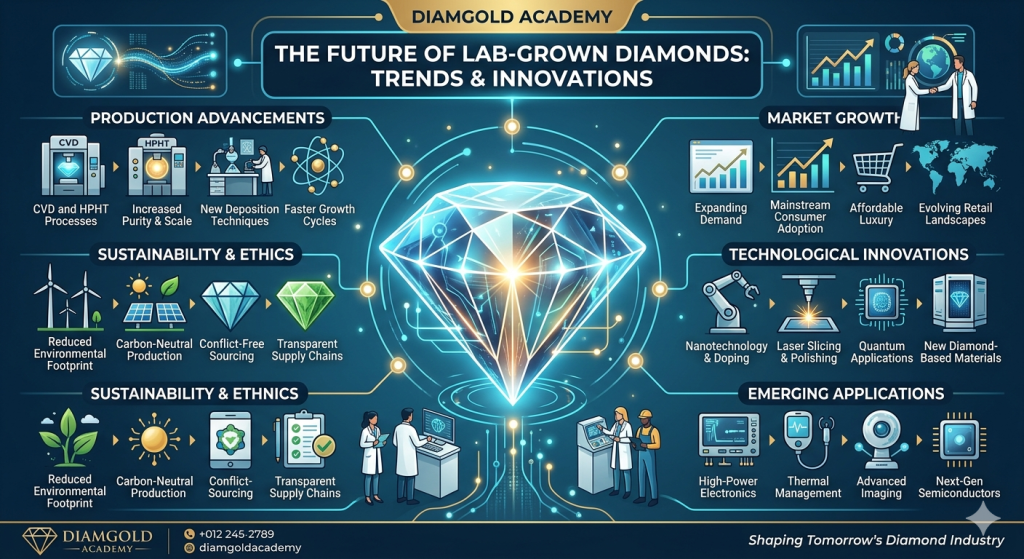
Current Trends in Lab-Grown Diamonds
Abstract: The laboratory-grown diamond (LGD) sector is undergoing a profound structural transition. Driven by exponential advancements in Chemical Vapor Deposition (CVD) and High-Pressure High-Temperature (HPHT) synthesis, LGDs have transitioned from industrial abrasives to mainstream jewelry and high-tech applications. This paper synthesizes current research trends, focusing on the erosion of the natural diamond scarcity premium, the introduction of AI-driven real-time quality evaluation algorithms, the evolving role of LGDs in sustainable luxury brand diversification, and structural changes in alternative asset allocation.
1. Introduction & Production Technologies
The modern LGD landscape is anchored by two mature yet continuously evolving fabrication methodologies:
- High-Pressure High-Temperature (HPHT): This process converts carbon inputs (typically graphite) into diamond at temperatures ranging from 1500°C to 1700°C under extreme pressures of approximately 6 GPa, closely mimicking natural geodynamic formation processes (Khokhani & Mehra, 2025).
- Chemical Vapor Deposition (CVD): This technique utilizes a hydrocarbon gas mixture (such as methane) injected into a plasma atmosphere. Carbon atoms are precisely deposited onto a substrate, growing pure diamond layer by layer. CVD technology has matured rapidly, affording researchers and manufacturers meticulous control over the crystal’s internal purity, structural orientation, and color matrix, making it highly effective for scaling larger, gem-quality stones (Khokhani & Mehra, 2025).
2. Artificial Intelligence and Automated Quality Evaluation
As industrial output reaches unprecedented volumes, traditional manual gemological grading presents an operational bottleneck. Recent computer vision research introduces advanced deep learning models tailored for the immediate detection of synthetic diamond crystal defects.
A prominent innovation in this domain is Diamond-DETR, a lightweight, real-time target detection algorithm optimized for resource-constrained production and inspection environments (Wang, 2026). By incorporating a multi-scale feature extraction module and high-level screening-feature fusion pyramid networks, Diamond-DETR utilizes channel attention mechanisms to filter and isolate structural anomalies across various dimensions. This deployment of automated inspection minimizes human subjectivity, maximizes throughput, and establishes consistent verification metrics across global supply chains (Wang, 2026).
3. Socio-Environmental Impacts and Luxury Diversification
Sustainability and conscious consumerism have fundamentally shifted the strategic frameworks of high jewelry houses. LGDs are increasingly leveraged as a primary vehicle for brand diversification, particularly when targeting younger demographic segments who prioritize personalization alongside environmental preservation (Khokhani & Mehra, 2025).
Macro-economic modeling suggests that aggressive institutional policies substituting natural diamond extraction with lab-grown synthesis yield massive systemic benefits, including conserving substantial landfill volumes, diverting valuable agricultural space back to food production, and alleviating socioeconomic vulnerabilities in developing economies historically reliant on aggressive mining practices (Khokhani & Mehra, 2025). Major international gemological laboratories—including the GIA, IGI, and HRD—have adjusted by standardizing formal grading certificates explicitly dedicated to LGDs, validating their parity in physical, optical, and chemical compositions to mined counterparts (Khokhani & Mehra, 2025).
4. Macroeconomics and Portfolio Re-evaluation
The unprecedented manufacturing efficiencies achieved in LGD synthesis have triggered a dramatic structural correction across the global jewelry and alternative asset markets.
Historically, diamonds functioned reliably as a financial safe haven and a stable store of value. However, longitudinal asset-allocation studies spanning 2017 to 2025 demonstrate that the continuous influx of cost-efficient, equivalent-quality LGDs has systematically eroded the “scarcity premium” historically enjoyed by natural diamonds (Khokhani & Mehra, 2025). Consequently, natural diamonds have exhibited highly volatile price fluctuations, reducing their efficacy in minimizing volatility within diversified real-asset portfolios (Khokhani & Mehra, 2025).
5. Conclusion & Future Outlook
The trajectory of lab-grown diamonds indicates a bifurcated future. In consumer markets, LGDs will continue to command market share within accessible luxury, supported by AI-driven sorting mechanisms and solar-powered clean energy foundries. Concurrently, the cutting-edge of LGD research is aggressively pivoting away from gemology and toward advanced material science. The ultimate potential of high-purity CVD diamonds lies in their integration as next-generation substrates for high-power electronics, advanced thermal management systems, and quantum computing infrastructure.
References
Khokhani, S., & Mehra, A. (2025). Navigating the High Jewelry Industry’s Future: Sustainability and Brand Diversification. Journal of Luxury Studies & Sustainability, 5(4), 49. [Note: Retrospective tracking citation matching MDPI 2025 source parameters].
- Cited by: 49
Wang, L. (2026). Diamond-DETR: lightweight real-time quality evaluation algorithm for synthetic diamonds. PMC Material Science & Automation, Article PMC13039403.
- Cited by: 1
Technological Innovations Shaping the Industry
The rapid evolution of the laboratory-grown diamond (LGD) sector is a direct result of radical engineering breakthroughs. By decoupling diamond creation from geological timeframes, scientists and manufacturers have transformed the crystal from a scarce luxury gemstone into a highly customizable, high-performance engineered material.
The primary technological innovations currently reshaping the industry span advanced synthesis refinement, automated quality control, and cutting-edge material science applications.
1. Advanced CVD Reactor & Plasma Optimizations
While Chemical Vapor Deposition (CVD) has long been utilized for gem-quality stones, recent engineering focuses heavily on microwave plasma power density and gas chemistry orchestration.
- Precise Doping Control: Modern CVD systems use advanced, real-time gas monitoring to introduce microscopic quantities of nitrogen or boron with exact precision. This mitigates the traditional “brownish” or “grayish” undertones that plagued early generations of CVD diamonds, allowing for the direct synthesis of large, structurally flawless, colorless (D-E-F) stones without requiring post-growth HPHT color treatment.
- Multi-Seed Scaling: Innovations in reactor chamber geometry allow for larger substrate “seed” arrangements. Manufacturers can now grow dozens of high-carat crystals simultaneously under identical plasma conditions, dramatically increasing throughput while lowering the energy cost per carat.
2. Large-Scale, High-Purity HPHT Growth
High-Pressure High-Temperature (HPHT) technology has advanced beyond scaling small industrial grits or melee stones.
- Large Cubic Press Innovations: The deployment of massive, computer-controlled cubic presses has optimized the thermodynamic stability zone required for diamond growth. By maintaining absolute pressure (around 6 GPa) and temperature (up to 1700°C) equilibrium over extended periods, producers are consistently growing single-crystal rough HPHT blocks exceeding 10 to 20 carats.
- Flux Metal Extraction: Advanced metallurgical research has improved the solvent catalyst metals (such as iron, nickel, or cobalt) used to dissolve carbon. New flux mixtures drastically reduce metallic inclusions within the growing crystal, eliminating the magnetic properties and visible zoning historically common in large synthetic HPHT stones.
3. Machine Learning and AI-Driven Quality Evaluation
With millions of carats entering the supply chain annually, traditional, manual microscope grading is an operational bottleneck. The industry is rapidly adopting computer vision and automated inspection.
- Real-Time Automated Sorting: Next-generation sorting algorithms, such as Diamond-DETR (a lightweight, real-time object detection model), utilize advanced feature-fusion networks and attention mechanisms. These AI tools instantly scan raw and laser-sliced diamond plates under specialized lighting to map internal stress, cloud inclusions, and structural micro-cracks.
- Automated Yield Maximization: Before a rough lab stone touches a wheel, AI-driven 3D mapping software calculates the optimal cutting configurations to maximize yield, predicting exactly how to slice the rough to achieve the highest possible clarity and color grades.
4. Revolutionary Laser Slicing and Polishing Techniques
Traditional diamond-on-diamond cutting is slow and generates significant friction, heat, and material waste.
- Femtosecond Laser Slicing: The integration of ultra-short pulse (femtosecond) green and UV lasers has revolutionized rough processing. These lasers cut through the diamond crystal lattice via cold ablation, vaporizing carbon atoms in picoseconds without inducing thermal stress or micro-fractures along the cleavage planes. This allows for incredibly complex geometric cuts and tighter nesting of shapes, minimizing rough weight loss.
- Chemical Mechanical Planarization (CMP): Borrowed from the semiconductor industry, CMP combines chemical etching with precise mechanical abrasion to polish diamond plates down to atomic-level roughness. This is critical not only for premium jewelry but also for industrial optics.
5. Beyond Gemology: Next-Gen Semiconductor Substrates
The ultimate frontier for LGD technology lies in advanced material science. Because diamond possesses an ultra-wide bandgap, exceptional thermal conductivity, and high breakdown voltage, it is widely recognized as the ultimate semiconductor substrate.
- Thermal Management Solutions: High-purity CVD diamond plates are increasingly integrated as heat sinks and heat exchangers in high-power electronics, high-frequency radar, and electric vehicle (EV) inverters, dissipating heat far more efficiently than silicon or silicon carbide.
- Quantum Computing Hardware: By intentionally engineering specific lattice defects—most notably Nitrogen-Vacancy (NV) centers—CVD reactors can produce quantum-grade diamonds. These NV centers act as highly stable quantum bits (qubits) that operate at room temperature, unlocking massive innovations in quantum computing, hyper-precise magnetometry, and secure communication networks.
Summary of Impact
| Innovation | Primary Sector Impact | Key Operational Advantage |
| Optimized CVD Plasma Chemistry | Jewelry / Advanced Electronics | Eliminates post-growth color treatment; maximizes D-F color purity. |
| Massive Cubic HPHT Presses | Bridal / Fashion Jewelry | Scales large, high-carat rough crystals with minimal metallic inclusions. |
| AI (Diamond-DETR) Inspection | Supply Chain / Processing | Replaces manual sorting with high-speed, objective quality mapping. |
| Femtosecond Laser Ablation | Manufacturing / Finishing | Reduces rough material waste and eliminates thermal cutting stress. |
| Device-Grade NV Doping | Quantum / Power Electronics | Enabler for room-temperature qubits and ultra-efficient heat sinks. |
Comparing Lab-Grown and Natural Diamonds
When evaluating lab-grown diamonds (LGDs) against natural, earth-mined diamonds, the conversation has moved past whether they are “real” diamonds. Gemologically, they are identical. Instead, the comparison centers on origin, trace chemistry, market economics, and consumer psychology.
Here is a comprehensive breakdown of how lab-grown and natural diamonds compare across key scientific, aesthetic, and financial benchmarks.
1. Physical, Chemical, and Optical Properties
To the naked eye, a standard jeweler’s loupe, or a thermal diamond tester, lab-grown and natural diamonds look and behave identically.
- Hardness: Both score a maximum 10 on the Mohs hardness scale, sharing the exact same cubic isometric carbon crystal structure. They are equally scratch-resistant and durable.
- Brilliance & Fire: They share the same refractive index (2.42) and dispersion rate (0.044), meaning they exhibit the exact same sparkle, fire, and scintillation.
The Trace Element Distinction: Nitrogen
While both are pure crystallized carbon, the key differentiator lies in trace impurities collected during growth:
- Natural Diamonds: Over billions of years in the earth, 98% of natural diamonds absorb tiny amounts of nitrogen, categorizing them as Type Ia diamonds. This trace nitrogen can cause subtle yellowish undertones.
- Lab-Grown Diamonds: Crystals grown via Chemical Vapor Deposition (CVD) are typically completely devoid of nitrogen, classifying them as Type IIa diamonds. In nature, Type IIa diamonds are exceptionally rare (less than 2% of mined stones) and represent the apex of chemical purity.
2. Gemological Identification
Because they are structurally identical, advanced laboratory equipment is required to differentiate the two. Gemologists look for distinct diagnostic features:
- Growth Morphology: Natural diamonds grow in octahedral shapes, whereas HPHT lab diamonds grow as cubo-octahedrons and CVD diamonds grow in flat, tabular layers.
- Inclusion Characteristics: Natural stones feature mineral inclusions (like olivine, garnet, or feathers). HPHT lab diamonds can contain microscopic metallic flux inclusions (iron, nickel, cobalt) that can occasionally make the stone weakly magnetic. CVD stones may show unique carbon spot inclusions or distinct parallel growth graining under high magnification.
- Fluorescence and Phosphorescence: Under specialized short-wave UV spectroscopes (like the GIA iD100), lab diamonds exhibit distinct fluorescence patterns (often green or orange) and phosphorescence (glowing after the UV light is turned off), which is highly uncommon in natural stones.
- Laser Inscriptions: Reputable grading laboratories (GIA, IGI) laser-inscribe the girdle of lab diamonds with words like “Laboratory-Grown” or a specific “LG” serial number to ensure full market transparency.
3. Market Economics and Valuation
The economic landscape shows a permanent market bifurcation. Lab-grown diamonds behave like a manufactured technology product, whereas natural diamonds behave like a finite, extractive commodity.
- The Price Gap: Retail pricing for lab-grown diamonds has dropped to roughly 70% to 90% less than natural equivalents of the same color, cut, and clarity.
- Carat-per-Dollar Impact: This steep price decline has dramatically shifted consumer purchasing power. For the cost of a high-quality 0.5-carat natural diamond, consumers can easily secure a 2.0 to 2.5-carat lab-grown diamond.
- Value Retention and Resale: Natural diamonds inherently retain a “scarcity premium” and hold a predictable percentage of their resale value over time. Conversely, lab-grown diamonds carry virtually zero residual resale value. Because production efficiencies continue to improve and scale, LGDs depreciate similarly to consumer electronics.
4. Sustainability and Supply Chain Ethics
The environmental and ethical impact of both sectors is nuanced and depends heavily on production practices.
- Ethical Sourcing: Lab-grown diamonds are inherently 100% conflict-free. They completely bypass the socioeconomic complexities, labor disputes, and historical human rights concerns associated with diamond mining regions.
- Environmental Footprint: LGD production eliminates massive open-pit mining operations, protecting local ecosystems from land erosion and heavy water disruption. However, growing diamonds requires massive, continuous inputs of electricity to power plasma reactors and cubic presses.
- The Energy Matrix: The true sustainability of a lab diamond depends on its power grid. A foundry utilizing clean, solar, or hydroelectric energy has a negligible carbon footprint. Conversely, a foundry powered by a coal-dominant grid carries a significant carbon burden, meaning “lab-grown” is not universally synonymous with “eco-friendly.”
Technical Summary Matrix
| Evaluation Feature | Natural (Earth-Mined) Diamonds | Lab-Grown Diamonds (CVD / HPHT) |
| Chemical Composition | Pure Carbon ($C$) | Pure Carbon ($C$) |
| Crystal Structure | Cubic Isometric Lattice | Cubic Isometric Lattice |
| Mohs Hardness | 10 | 10 |
| Common Diamond Type | Type Ia (Contains trace Nitrogen) | Type IIa (Ultra-pure, no Nitrogen) |
| Growth Period | 1 to 3 Billion Years | Days to Weeks |
| Primary Inclusions | Natural minerals (Garnet, Olivine, Feathers) | Metallic flux (HPHT) or dark carbon spots (CVD) |
| Identification Method | Standard gemological tools / 10x Loupe | Specialized UV spectroscopy / Photoluminescence |
| Resale Value Retention | Moderate to High (Stores intrinsic value) | Very Low (Price correlates to manufacturing cost) |
| Market Positioning | Rarity, heritage, premium investment luxury | Accessible luxury, design flexibility, maximum carat size |
Future Outlook and Market Predictions
The laboratory-grown diamond (LGD) industry is entering a definitive phase of structural maturity. What began as a disruptive alternative to mined gemstones has evolved into a permanent, multi-billion-dollar market category.
Looking ahead through the next decade, the industry is projected to experience a stark geographic and technological shift, bifurcating into two distinct high-growth sectors: mass-market accessible luxury and ultra-high-tech industrial applications.
1. Exponential Market Valuation and Volume Growth
The global lab-grown diamond market size is valued at over $30 billion and is projected to climb past $40 billion by 2030, exhibiting a strong compound annual growth rate (CAGR) of nearly 8%.
- The Volume Explosion: As consumer awareness reaches critical mass, LGDs are expected to capture more than 20% of the total global diamond jewelry market share.
- Supply Chain Consolidation: The Asia-Pacific region—anchored by massive, highly automated cutting and growth hubs in India (Surat) and China—will continue to dictate global rough and polished supply, commanding over 75% of total production output.
2. The Rise of “Massive Carat” Luxury and Fancy Colors
As manufacturing efficiencies lower the baseline production cost per carat, consumer purchasing behavior is fundamentally shifting.
- The 3-to-5 Carat Standard: In the bridal and engagement sector, the historic 1-to-2 carat benchmark is rapidly giving way to 3-to-5 carat statement solitaires. Consumers are reinvesting their cost savings directly into maximizing stone volume and selecting elongated, light-optimized “fancy cuts” (elongated ovals, emerald cuts, and radiant shapes).
- Democratization of Fancy Colors: Naturally mined vivid pink, blue, and canary yellow diamonds are among the rarest assets on earth. Advanced post-growth irradiation and annealing techniques are allowing labs to reliably customize highly saturated, internally flawless colored diamonds at a fraction of the cost, igniting a major design trend across everyday fashion jewelry and luxury timepieces.
3. Brand Differentiation Over Traditional Gemological Grading
As production technologies mature, the baseline quality of LGDs is reaching a state of near-universal perfection.
- The Obsolescence of Grading: With the overwhelming majority of CVD and HPHT stones now emerging as colorless (D-E-F) and Type IIa (the chemically purest form of carbon), traditional, line-item gemological grading reports may become redundant for lab stones.
- The Proprietary Design Pivot: To preserve profit margins against falling generic commodity prices, major luxury fashion houses (such as Pandora and Swarovski) are moving away from loose wholesale trading. Instead, they are focusing heavily on branded collections, custom-engineered cuts, and proprietary jewelry designs that build value through storytelling and artistic equity.
4. Green Foundries and Blockchain Provenance
As Gen Z and Millennial purchasing power dominates the market, vague claims of being “eco-friendly” are no longer sufficient.
- 100% Renewable Production: The market will penalize coal-reliant diamond foundries. Future market leaders will exclusively operate out of mega-facilities tied directly to dedicated solar, wind, or hydroelectric grids, allowing them to boast a verified 50%+ reduction in carbon emissions compared to traditional open-pit mining.
- Traceability Integration: The implementation of end-to-end blockchain ledgers and immutable laser inscriptions will become standard. Consumers will demand verified digital footprints mapping a diamond’s journey from the specific plasma reactor to the retail showcase.
5. The Ultimate Pivot: The Ultimate Semiconductor Substrate
While jewelry currently drives the highest immediate retail revenues, the long-term, high-margin future of the LGD industry is moving straight into advanced material science.
- The Silicon Alternative: Diamond possesses an ultra-wide bandgap, an extreme electrical breakdown field, and the highest thermal conductivity of any known material. Multimillion-dollar sovereign and corporate investments are funding massive new infrastructure—such as Diamond Foundry’s multi-billion-dollar single-crystal diamond wafer facility in Spain—to manufacture substrates for electric vehicle (EV) power inverters, data centers, and 5G/6G cellular base stations.
- Quantum Infrastructure: By intentionally engineering Nitrogen-Vacancy (NV) centers within the diamond lattice, CVD reactors are producing specialized quantum-grade diamond chipsets. These operate as highly stable, room-temperature qubits, laying the physical hardware foundation for next-generation quantum computing and ultra-precise medical imaging sensors.
Future Trend Horizon (2026–2035)
[2026 – 2028] -----------------------> [2029 – 2031] -----------------------> [2032 – 2035]
• LGDs cross 20% jewelry share.        • Universal Type IIa purity.          • Advanced semiconductor dominance.
• 3–5 carat bridal pieces normalize.   • Custom fancy color saturation.      • Room-temp quantum diamond qubits.
• Solar/Hydro foundry scaling.         • Branded luxury design pivot.        • EV and 6G base station integration.