
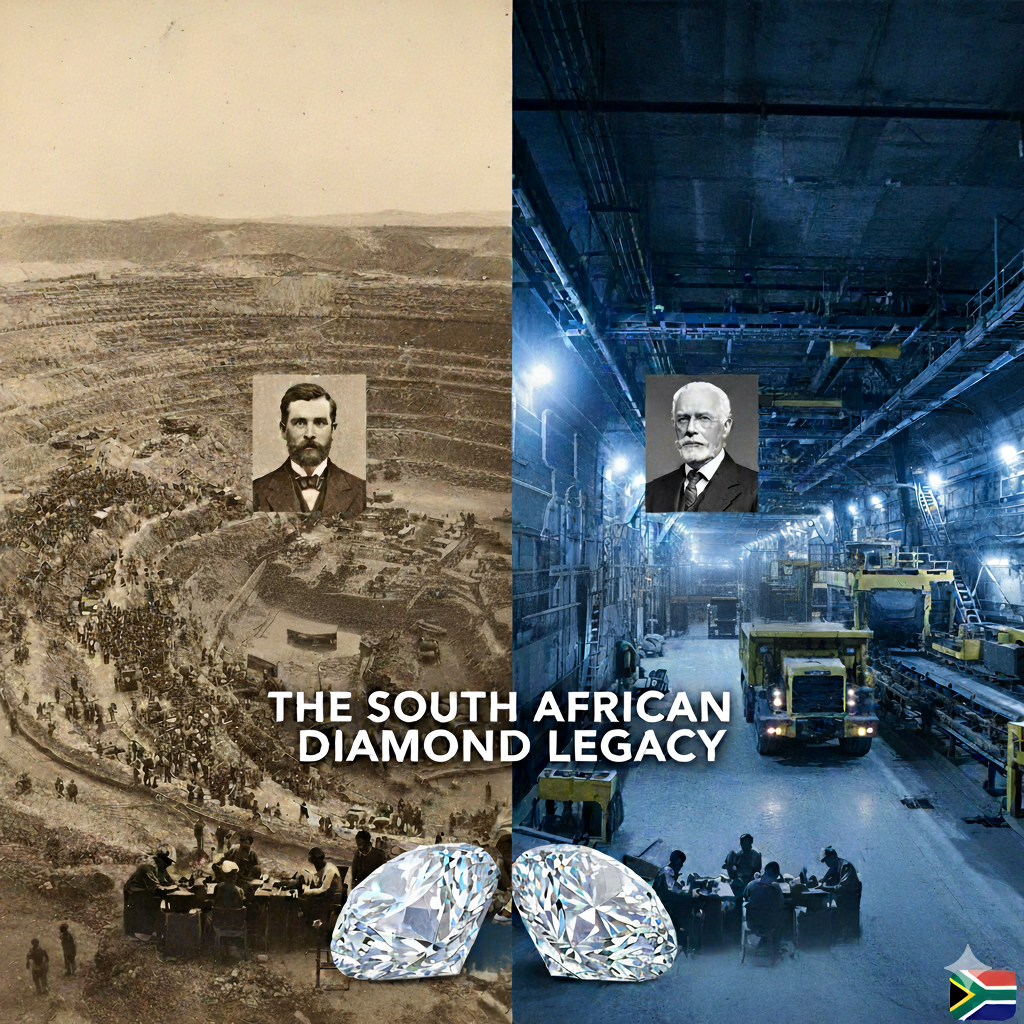
The Kimberley Legacy: De Beers and the Evolution of the South African Diamond Industry.
South Africa is not just a major diamond-producing nation; it is the birthplace of modern industrial-scale diamond mining and the foundation upon which the world’s most enduring diamond conglomerate, the De Beers Group, was built. The industry’s history here is a story of immense wealth, geopolitical control, social transformation, and, more recently, adaptation to a changing global market.
The Rush and the Rise of a Monopoly (1867-1929)
The South African diamond saga began with the discovery of the “Eureka” diamond in 1867 near the Orange River. This led to the great diamond rush that culminated in Kimberley, where the kimberlite pipes—the geological source of diamonds—were first mined on a massive scale.
The early Kimberley diggings were chaotic, leading to thousands of small, independent claims. It was the strategic vision of one man, Cecil John Rhodes, and his financier, Alfred Beit, who consolidated these claims. By 1888, through a series of shrewd acquisitions and mergers, Rhodes founded De Beers Consolidated Mines, Ltd. The company soon achieved a virtual monopoly, controlling nearly all of South Africa’s diamond production.
This control was cemented by two key figures:
- Cecil John Rhodes: Created the vertical integration by merging the De Beers and Kimberley mines.
- Sir Ernest Oppenheimer: A German immigrant who joined the board in 1926 and, alongside his company Anglo American, systematically built and consolidated the global monopoly, using the Central Selling Organisation (CSO) to regulate supply and stabilize (or inflate) global diamond prices for much of the 20th century.
De Beers and the Post-Apartheid Era
The relationship between the diamond industry and South Africa has always been complex, reflecting the country’s social and political history. Following the end of apartheid, the industry faced pressure to address historical inequalities and align with the principles of democratic South Africa. Key legislative changes forced a transformation:
- The Mineral and Petroleum Resources Development Act (MPRDA) of 2002: This legislation transferred mineral rights from private companies to the state, requiring mining firms to apply for new rights and adhere to new social and economic targets.
- Broad-Based Black Economic Empowerment (BEE): De Beers and others were required to implement BEE deals, promoting black ownership in their local South African operations. In 2005, De Beers sold a 26% stake in De Beers Consolidated Mines (DBCM), its South African subsidiary, to the BEE consortium Ponahalo Investments.
This period saw De Beers begin to divest from some of its older, higher-cost mines in South Africa (like Finsch and Cullinan, which are now run by Petra Diamonds), shifting its global focus toward higher-value joint ventures in Botswana and Namibia.
The Current Landscape: Underground and Beneficiation
Today, the South African diamond industry is characterized by maturity, deep underground operations, and a focus on beneficiation:
- Flagship Operations: De Beers’ major remaining South African asset is the Venetia mine in Limpopo province. The open-pit operation has been converted into a massive underground mine through a US$2 billion investment, designed to extend the mine’s life beyond 2040 and secure its position as South Africa’s largest producer.
- Beneficiation Focus: South Africa, like other diamond-producing African nations, is pushing to capture more of the diamond’s value locally. Beneficiation involves the local cutting, polishing, and manufacturing of diamonds instead of simply exporting the rough stones. De Beers supports this through its Sightholder Sales South Africa which supplies rough diamonds to local cutting operations.
- Key Players: While De Beers remains a crucial anchor, the South African sector is no longer a monopoly. Independent producers like Petra Diamonds now operate iconic, deep-level mines like Cullinan (home of the largest diamond ever found, the Cullinan Diamond) and Finsch.
- Challenges: The industry faces significant headwinds, including:
- Cost and Logistical Issues: Energy supply constraints (load-shedding) and logistical bottlenecks increase operating costs.
- Illegal Mining: The presence of unauthorized miners (“zama zama”) around historic sites and active operations poses a security and environmental risk.
- Lab-Grown Competition: The rise of cheaper, high-quality lab-grown diamonds in the jewelry market is exerting downward pressure on the price of natural rough stones.
This is a highly insightful article! The examination of De Beers’ historical monopoly in South Africa is crucial for understanding the country’s economic and social development. It’s a powerful narrative, moving from Cecil Rhodes’ aggressive consolidation in the 19th century to the more recent, complex efforts towards Black Economic Empowerment (BEE) and beneficiation.
The shift in the industry’s focus, from the Big Hole-era dominance to modern, deep-level projects like the Venetia underground mine, demonstrates a pragmatic evolution. We appreciate the author highlighting both the immense wealth generated and the challenges remaining, particularly around local value addition and adapting to new market pressures. An essential read for anyone studying the intersection of geology, economics, and history!