
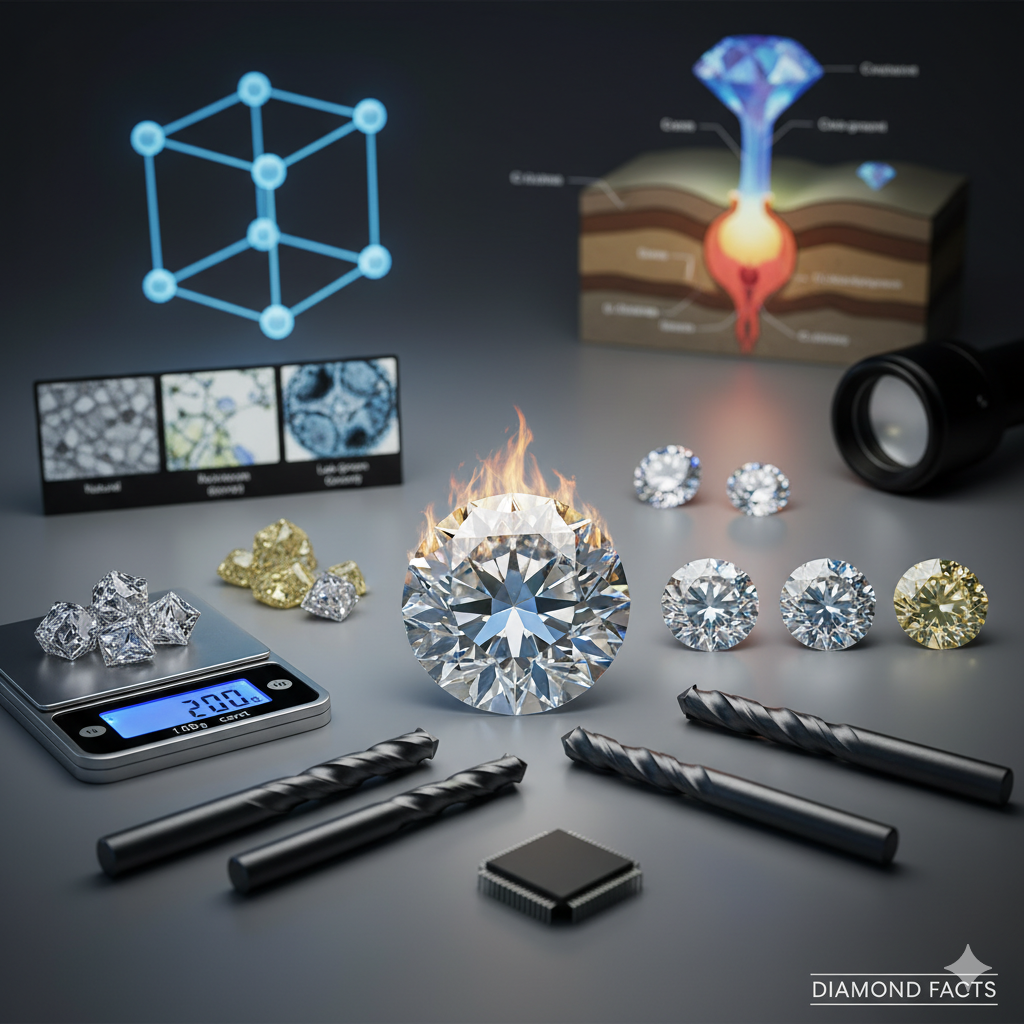
Diamonds, the hardest known natural substance, have captivated humanity for centuries. Coveted for their brilliance, durability, and rarity, these crystalline forms of carbon are more than just beautiful gemstones; they’re a testament to geological forces and scientific intrigue.
Formation and Properties
A diamond’s journey begins deep within the Earth, typically 150 to 200 kilometers below the surface, within the Earth’s mantle. Under immense heat (around $900^\circ\text{C}$ to $1300^\circ\text{C}$) and pressure (45 to 60 kilobars), carbon atoms bond in a highly rigid, tetrahedral crystal lattice structure. This unique arrangement is what grants diamonds their extraordinary hardness, making them a 10 on the Mohs scale of mineral hardness.
Diamonds are brought to the Earth’s surface through deep-source volcanic eruptions that travel rapidly, preventing the diamonds from turning back into graphite (a softer form of carbon). These eruptions form vertical pipes of rock known as kimberlite or lamproite, the primary sources of mined diamonds.
The physical properties of diamonds are key to their many uses:
- Hardness: Used in industrial applications like cutting, drilling, and grinding tools
- High refractive index: Causes the intense sparkle and “fire” when cut into a gemstone.
- High thermal conductivity: Used in electronics to dissipate heat.
- Chemical inertness: Resists corrosion and chemical reactions.
The Four Cs of Diamond Quality
When assessing the quality and value of a cut diamond, four main characteristics—known as the “Four Cs”—are universally used:
- Carat Weight: This measures the diamond’s mass One carat is equal to 200 milligrams (0.2 grams) The value typically increases exponentially with carat weight, as larger diamonds are rarer.
- Cut: Often considered the most important “C” for a diamond’s beauty. It refers not to the shape (like round or princess) but to the proportions, symmetry, and polish of the facets. A well-cut diamond maximizes the reflection and refraction of light, resulting in greater brilliance (total light reflected) and fire (dispersion of light into colors)
- Color: Gem-quality diamonds are graded on a scale from D (colorless) to Z (light yellow or brown). Completely colorless diamonds are the rarest and most valuable. Note that this scale does not apply to “fancy color” diamonds (e.g., blue, pink, red), which are valued based on the intensity and rarity of their hue.
- Clarity: This measures the presence of inclusions (internal flaws) and blemishes (surface imperfections). Clarity is graded from Flawless (FL) to Included (I), with Flawless diamonds being the rarest. Most diamonds used in jewelry fall into the VS (Very Slightly Included) or SI (Slightly Included) categories.
Common Questions and Answers
Q: What is the difference between natural and synthetic (laboratory-grown) diamonds?
A: Natural diamonds are formed deep within the Earth over billions of years. Synthetic diamonds (also known as lab-grown or cultured diamonds) are created in a controlled laboratory setting, typically using High-Pressure/High-Temperature (HPHT) or Chemical Vapor Deposition (CVD) methods. Crucially, they possess the same chemical composition, crystal structure, and physical properties as natural diamonds.21 The main difference is their origin and sometimes the microscopic internal growth patterns that gemologists can use for identification.
Q: Why are diamonds so often associated with engagement rings?
A: This tradition largely stems from a successful marketing campaign launched in the late 1930s by the De Beers company, featuring the enduring slogan, “A Diamond Is Forever.” The diamond’s inherent durability and rarity were positioned as symbolic of enduring love and commitment, linking the gemstone inextricably to the concept of eternal marriage.
Q: What gives fancy color diamonds their color?
A: The presence of trace elements or structural defects in the diamond’s crystal lattice is responsible for fancy colors. For example:
- Yellow and Orange: Caused by nitrogen atoms.
- Blue: Caused by trace amounts of boron.
- Green: Caused by natural radiation exposure.
- Pink and Red: Caused by plastic deformation in the crystal structure during formation.
Q: Are all diamonds used in jewelry?
A: No. A significant portion of mined diamonds, roughly 75-80% by weight, are classified as industrial-grade (called bort or crushing boart) due to their lower clarity, less attractive color, or smaller size. These diamonds are essential for their unmatched hardness and are used in tools like drill bits, saw blades, grinding wheels, and other high-precision machinery.
This is an exceptionally well-crafted and informative piece. We appreciate how the author not only delves into the geological science behind diamond formation but also clearly breaks down the crucial metrics of value—the Four Cs (Carat, Cut, Color, Clarity).
The section clarifying the distinction between natural and synthetic diamonds is particularly valuable for our readers navigating modern jewelry purchasing decisions. This article sets a high standard for educational content on the site. Thank you DIAMGOLD for this excellent contribution!