
Business Plan, This is a general template, Specific requirements to comply are required by the SADPMR
The Mining Charter, specifically the 2018 iteration, outlines various requirements for mining companies to achieve compliance. Here’s a breakdown of the key areas:
1. Ownership:
- New mining rights: Require a minimum of 30% ownership by Historically Disadvantaged South Africans (HDSA). This includes:
- 5% non-transferable carried interest each for Host Communities and Qualifying Employees.
- 20% minimum ownership for BEE (Broad-Based Black Economic Empowerment) Entrepreneurs.
- Existing rights: Companies holding existing rights with 26% HDSA ownership are considered compliant and don’t need to increase their shareholding.
2. Mineral Beneficiation:
- Aims to add value to mined minerals through processing and beneficiation within South Africa.
- Companies need to demonstrate a plan for beneficiation and achieve specific targets based on the type of mineral.
3. Procurement:
- Requires a minimum of 70% procurement (goods, services, consumables) from South African companies, with specific targets for HDSA-owned businesses.
4. Supplier and Enterprise Development:
- Aims to empower HDSA businesses by fostering supplier and enterprise development partnerships.
- Companies need to invest in developing HDSA suppliers and demonstrate progress towards set targets.
5. Human Resources Development (HRD):
- Focuses on skills development and training for South Africans, particularly HDSA individuals.
- Companies need to invest a minimum of 5% of their annual HDSA payroll on HRD initiatives.
6. Mine Community Development (MCD):
- Aims to uplift communities affected by mining activities through social and economic development projects.
- Companies need to engage with communities, identify their needs, and contribute financially and through projects towards their development.
7. Employment Equity:
- Promotes fair representation of different population groups within the mining industry, with specific targets for black people and black females at various levels of the workforce.
8. Principles for Housing and Living:
- Outlines provisions for decent living conditions for mine employees, including upgrading hostels, promoting family units, and exploring ownership options.
Compliance Scorecard:
- The Department of Mineral Resources and Energy (DMRE) uses a scorecard system to assess mining companies’ compliance with the Charter.
- A minimum score of 60% is required for full compliance.
Navigating the Broad-Based Socio-Economic Empowerment Charter in the Diamond and Precious Metals Industry
The mining industry, including diamond and precious metals exploration and development, plays a crucial role in South Africa’s economy. To ensure equitable participation and responsible resource utilization, the Broad-Based Socio-Economic Empowerment Charter (BBEE Charter) outlines essential guidelines for applicants seeking licenses and permits.
This blog post offers a simplified overview of the BBEE Charter requirements specific to diamond and precious metal industries, as mandated by the Mineral and Petroleum Resources Development Act (MPRDA) and its amendments. It’s important to remember that this summary is for general informational purposes only and doesn’t supersede the full BBEE Charter document.
Key Requirements for Diamond Dealers Licence Applicants: Business Plan
- Human Resources Development (HRD):
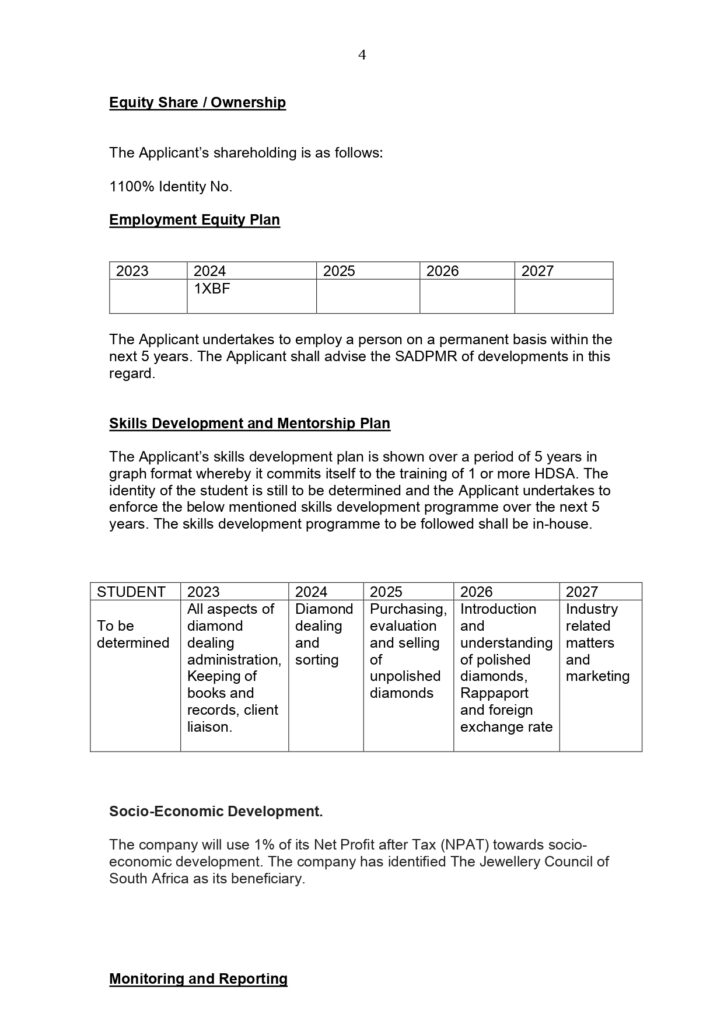
- Skills Development Plan: Outline training programs to empower employees, specifically historically disadvantaged groups (HDGs), with relevant skills and enhance their career prospects.
- Mentorship Plan: Create a structured program to guide and prepare HDG employees for leadership roles, aligning with the employment equity target of 40% HDSA participation in management within five years.
- Internship and Bursary Plan: Offer financial support (bursaries) and practical training opportunities (internships) to HDG individuals, particularly in diamond and precious metals-related fields.
- Employment Equity Plan:
- Develop a plan to achieve 10% female participation and 40% HDSA participation in management within five years, establishing concrete targets and timelines for senior and junior positions.
- Procurement Plan:
- Implement a strategy to increase procurement from HDG companies and individuals.
- Prioritize HDG suppliers and establish partnerships where necessary to address resource limitations.
- Ownership and Joint Ventures:
- Aim to achieve 26% ownership of diamond and precious metals industry assets by HDGs within ten years and 15% within five years.
- Explore various options, such as share sales, partnerships, and joint ventures with HDG entities, ensuring they hold at least 50% + 1 voting share and management control.
- Monitoring and Reporting:
- Submit annual reports verified by external auditors, detailing progress towards achieving BBEE plan commitments.
- Collaborate with regulators who monitor implementation progress.
- Undertaking:
- Sign a formal commitment to adhere to the BBEE plan within a specified timeframe. This serves as a condition for granting licenses and can lead to revocation in case of non-compliance.
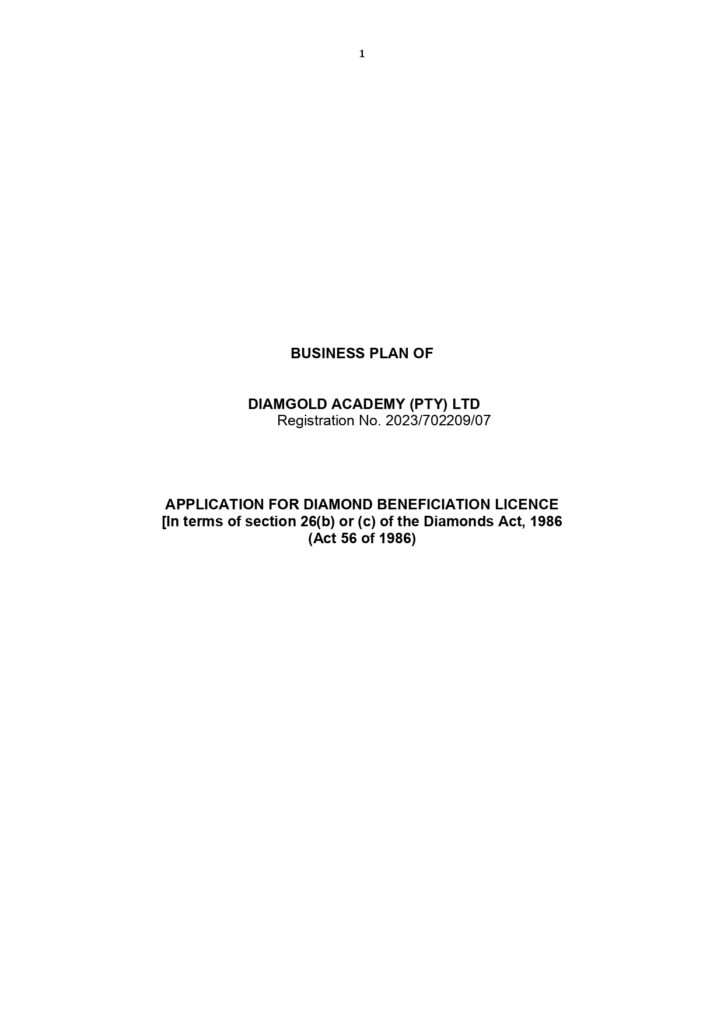
Business Plan Tempelate
I. Executive Summary
- Briefly introduce your company and its proposed diamond business activities.
- Highlight your experience, qualifications, and commitment to ethical and responsible diamond practices.
- Summarize your key financial projections and growth plans.
II. Company Description
- Company Name:
- Legal Structure (e.g., Sole Proprietorship, Partnership, Limited Liability Company):
- Year Established:
- Business Address:
- Management Team: Briefly introduce your key personnel and their relevant experience and qualifications.
III. Diamond Business Activities
- Type of Diamond Licence Sought (e.g., Diamond Dealer, Diamond Beneficiation):
- Describe your intended scope of operations:
- Will you be buying, selling, importing, exporting, or cutting diamonds?
- What types of diamonds will you be dealing in (rough, polished, specific categories)?
- Target Market: Who are your intended customers and suppliers?
- Competitive Analysis: Briefly discuss the competitive landscape and your unique selling proposition.
IV. Compliance and Ethical Sourcing
- Demonstrate your understanding of and commitment to complying with all relevant diamond regulations, including Kimberley Process Certification Scheme (KPCS) requirements.
- Outline your procedures for ensuring the ethical sourcing of diamonds, including due diligence and conflict-free sourcing practices.
V. Marketing and Sales Strategy
- Describe your marketing and sales plan to reach your target market.
- Specify the channels you will use to source and sell diamonds.
VI. Management Team and Personnel
- Provide details about your management team’s experience and qualifications in the diamond industry.
- Outline your plan for staffing your business, including the number and qualifications of employees required.
VII. Financial Projections
- Present a financial forecast for the next 3-5 years, including:
- Projected revenue and expenses
- Cash flow statements
- Profit and loss statements
- Balance sheets
- Demonstrate financial viability and your ability to sustain the business.
VIII. Risk Assessment
- Identify potential risks associated with your business operations, such as market fluctuations, supply chain disruptions, and regulatory changes.
- Describe your mitigation strategies for addressing these risks.
IX. Conclusion
- Summarize the key points of your business plan and reiterate your commitment to ethical and responsible diamond practices.
- Express your confidence in the success of your business and your ability to contribute positively to the diamond industry.
X. Appendix
- Include any supporting documents, such as:
- Letters of intent from potential customers or suppliers
- Resumes of key personnel
- Financial statements (if available)
- Proof of compliance with relevant regulations (e.g., KPCS certificate)
Remember: Specific requirements may vary;
Business Plan; Demystifying Diamond Licenses: A Guide for Aspiring Applicants with Support from Evan Roberts
The allure of the diamond industry has captivated imaginations for centuries. Today, entering this captivating world requires navigating the complex process of obtaining a diamond license. While the specific requirements vary significantly by location and intended activities, this article provides a general framework to guide aspiring applicants, while highlighting the valuable support offered by Evan Roberts, a reputable consultant specializing in diamond license applications.
Understanding the Landscape:
The diamond industry operates within a tightly regulated environment, with each country establishing its own licensing framework. This framework typically involves various authorities overseeing different aspects, such as diamond trading, cutting, and polishing. Familiarizing yourself with the specific regulatory body and applicable legislation in your target jurisdiction is crucial.
Types of Diamond Licenses:
The type of license you require depends on your intended business activities within the diamond industry. Some common licenses include:
- Diamond Dealer License: Permits buying, selling, and importing/exporting rough and polished diamonds.
- Diamond Cutting and Polishing License: Authorizes the cutting and polishing of rough diamonds.
- Diamond Beneficiation License: Allows adding value to rough diamonds through various processes like cutting, polishing, and setting.
It’s essential to thoroughly research the specific requirements and limitations associated with each license type before applying.
Crafting a Compelling Application:
A well-structured application package plays a vital role in the success of your license application. This typically includes:
- Completed application form: Ensure accuracy and completeness while adhering to the specific format and instructions provided by the relevant authority.
- Comprehensive business plan: This document outlines your company’s objectives, operational details, and financial projections, demonstrating your understanding of the industry and commitment to ethical practices.
- Supporting documents: These may include proof of registration, financial statements, letters of intent from potential suppliers and customers, and evidence of compliance with relevant regulations (e.g., Kimberley Process Certification Scheme certificate).
Navigating the Complexities with Evan Roberts:
The diamond licensing process can be intricate and involve complex legal and regulatory nuances. Engaging a reputable consultant specializing in diamond license applications like Evan Roberts (https://evanroberts.co.za) can be invaluable.
With extensive experience in the industry, Evan Roberts offers a comprehensive range of services to support applicants throughout the process, including:
- Guidance on selecting the appropriate license type based on your business goals.
- Assistance in completing application forms and gathering necessary documentation.
- Development of a compelling business plan that meets regulatory requirements and showcases your company’s potential.
- Liaison with regulatory bodies and representation during the application process.
Conclusion:
Obtaining a diamond license opens doors to exciting opportunities in the industry. However, thorough research, meticulous preparation, and potentially, professional guidance from Evan Roberts are critical for navigating the application process successfully. Remember, this article provides a general overview, and specific requirements will always vary depending on your location and intended business activities.